
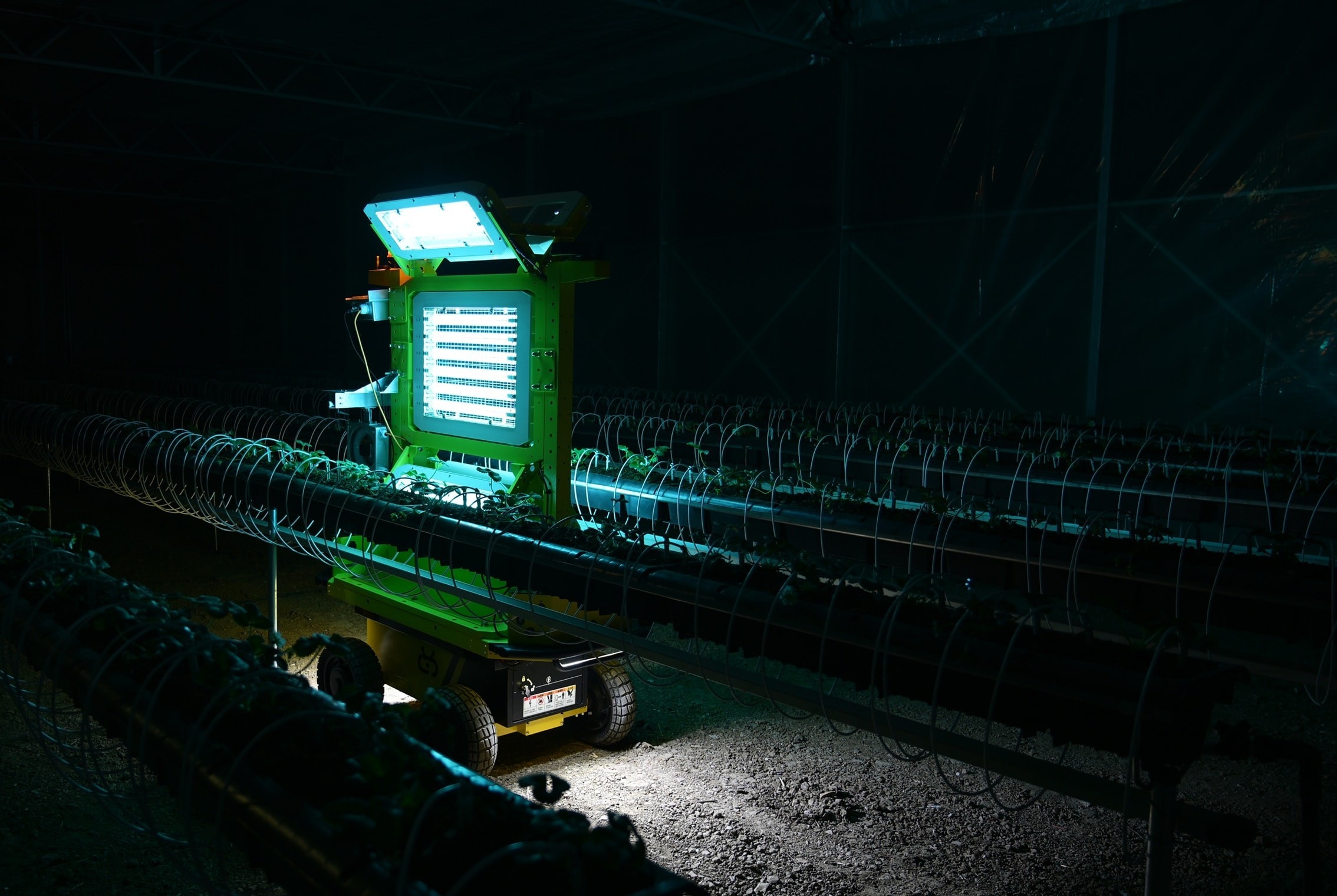
U303
Ask Our ExpertWheeled UV-C Robot
U303 is an autonomous, agile, accurate UV-C treatment robot, targeting fungal diseases on crops in facility agriculture.
Download Product Brochure
Key Features
Parameters
| Parameter | Value |
|---|---|
| Dimensions (L×W×H) | 1350×633× (1,300-1,800) mm |
| Weight | 170 kg |
| Battery | 48V-80 Ah (54.5 V charge cut-off) |
| Steering type | Skid steering |
| Tyres | 13 x 4.30 - 8 (tubeless) |
| Operation time (Full battery) | 2.5 h |
| Connectivity | Wi-Fi, 4G/5G, GNSS |
| Operation modes | Manual/Semi-autonomous/ Fully autonomous |
| Angle of approach/ departure | 25° |
Frequently Asked Questions About UV-C

1.How does UV-C work?

UV-C radiation works by damaging the DNA of fungal pathogens, inhibiting their growth and spread. The treatment is most effective when done during night time, as fungal pathogens lose their self-repair capability without sunlight; they are “killed” permanently.
2.Why is UV-C better than chemicals?
Traditional chemical treatment has many limitations which are not present with UV-C. For example, it increases the humidity of the environment, which can lead to a higher incidence of fungal diseases, and the air movement initiated by spray can spread spores between plants. In addition, chemical resistance is increasing among fungus, so sprays are becoming less effective. Spraying chemicals also limits a farm's harvesting operation - human pickers are typically not allowed to enter tunnels for a few days after chemical spraying has been carried out.
In contrast, UV-C does not increase humidity, does not cause spore spreading, is impervious to biological resistance, and has no impact on harvest scheduling. This also helps you to meet more and more stringent restriction of chemical usages.
3.Can UV-C radiation reach and treat the entire leaf surface, including areas that are partially concealed or already infected?
Its effectiveness depends on direct exposure, as the radiation intensity decreases with distance and UV-C may not adequately reach leaves or fruit concealed within the crop canopy.
To address this challenge, our U303 robot features adjustable irradiation angles, enabling treatment from different directions, including the front and rear of the crop canopy.
Our technology is designed to deliver an appropriate UV-C dose based on three key factors: treatment frequency, exposure time and distance from the target. These parameters are carefully controlled to help achieve effective treatment.
The treatment is best when the farm deleafs and has good husbandry as the UV-C can penetrate better in these conditions.
4.Can UV-C also treat infected fruit effectively?
Our approach focuses primarily on prevention, we typically start treatment soon after planting, when the plants are still young. Consequently, fruit infections are relatively uncommon in crops treated using our technology.
Our experiments have also demonstrated that direct UV-C treatment of infected fruit over seven consecutive days can eliminate visible powdery mildew symptoms and prevent further spread under the conditions tested.
5.Does UV-C treatment affect flowering?
Under our recommended operating conditions, UV-C treatment has shown no discernible adverse effects on flowering. The robot exposes each target area for only a few seconds at a time, with exposure duration and intensity carefully controlled to deliver an appropriate dose while minimizing potential adverse effects on the crop.
6.Is UV-C radiation emitted continuously or in intermittent pulses?
The UV-C lamps emit radiation continuously while the robot is operating. As the robot moves along the crop rows, it travels slowly past each plant or target area to deliver the required exposure.
To ensure an appropriate UV-C dose, we have established recommended operating parameters, including treatment frequency, robot travel speed and UV-C wavelength.
7.Does the technology target all fungal pathogens, or is its efficacy limited to specific species? Which fungal diseases can it control most effectively?
UV-C treatment can be effective against certain fungal diseases, with strawberry powdery mildew being our primary target and a key area in which we have demonstrated efficacy. In many customer cases, we have seen UV-C effectively control powdery mildew on 95% of strawberry plants, with increases in yield up to 30%.
However, efficacy varies depending on the fungal species, crop conditions and treatment parameters. We therefore focus on validating our technology against specific pathogens rather than claiming universal effectiveness against all fungal diseases.
8.Which crops have been validated, and which are currently recommended?
Strawberries are currently our primary recommended crop. Our UV-C technology has been widely deployed in strawberry farms, where we have extensive experience in practically applying our technologies.
We are also testing and validating the technology for other crops, including blueberries and grapes. We believe the UV-C treatment could be applied to a wide range of crops.
9.How much area can one robot cover?
The area coverage is related to the movement speed of the robot during treatment. Based on our practice in strawberry farms, one robot of U303 can cover 1-2 hectares (depending on the tunnel layout, ground conditions and dosage requirement).
The high performance U501/U502 for ground strawberries can cover larger areas.
10.Will the UV-C burn the crops?
Antobot’s experts will determine the best dosage for the actual usage scenario with customers, to ensure the radiation is not exceeding the safety level. In addition, the robot has a built-in safety mechanism: if the robot stops for over 3 seconds, the UV-C light will turn off instantly.
11.When is it safe to re-enter a tunnel after treatment?
Currently spraying has at least a 24 hour requirement. Unlike chemical spraying, UV-C is a physical light treatment that leaves no chemical residue on the crop. Once treatment is complete, the lamps are switched off and the area has been confirmed safe for access, harvesting can resume immediately without a UV-C-specific pre-harvest or chemical re-entry interval. UV-C also adds no moisture to the crop, avoids mixing and handling crop-protection chemicals, supports lower-residue and IPM programmes, and can operate autonomously at night without disrupting normal harvesting and daytime farm activities. Direct exposure to operating UV-C lamps must still be prevented because UV radiation can damage the eyes and skin.